+86-731-82739266
info@topsflo.com
The Leader of High-end Micro DC Pump in China

 +86-731-82739266
Industry Overview
Home energy storage is rapidly becoming a mainstream solution as rising electricity prices, grid instability, and growing demand for energy independence drive residential battery adoption worldwide. As battery capacities increase, traditional air cooling is struggling to meet higher thermal management requirements.
Liquid cooling offers more precise temperature control, enhanced safety, lower operating costs, and better support for high-energy-density battery systems. As a result, it is increasingly viewed as the future of residential energy storage.
Quick Answer
What is liquid cooling in home energy storage?
Liquid cooling uses a closed-loop circulation system to transfer heat away from battery packs and maintain optimal operating temperatures.
Why is liquid cooling replacing air cooling?
Compared with air cooling, liquid cooling provides better heat dissipation, more consistent temperatures, lower noise, and improved efficiency for larger battery systems.
Is liquid cooling the future of home energy storage?
As residential battery systems evolve toward higher capacities and integrated designs, liquid cooling is becoming the preferred thermal management solution.
• According to the International Energy Agency (IEA), battery energy storage is among the fastest-growing technologies supporting the global clean energy transition.
• BloombergNEF (BNEF) expects continued expansion of stationary energy storage installations as battery costs decline and renewable energy adoption increases.
• Wood Mackenzie reports strong growth in Europe’s residential energy storage market as households increasingly pair solar PV systems with battery storage.
• The European Association for Storage of Energy (EASE) identifies thermal management as a critical factor affecting battery safety, efficiency, and service life.
The residential energy storage market is experiencing rapid growth worldwide.
Several factors are accelerating adoption:
• Rising electricity prices;
• Increasing concerns over grid reliability;
• Greater use of rooftop solar systems;
• Government support for clean energy;
• Growing consumer interest in energy independence.
By combining solar panels with battery storage, homeowners can:
• Increase self-consumption of renewable energy;
• Reduce dependence on utility providers;
• Protect against electricity price volatility;
• Maintain backup power during outages.
Europe has emerged as one of the fastest-growing residential energy storage markets following the energy crisis, while regions with unstable power supply are also driving demand for household backup systems.
As battery capacities continue to increase, thermal management technologies must evolve accordingly.
Traditional air cooling gained popularity because of its simple structure and relatively low upfront cost. However, increasing battery energy density is exposing its limitations.
Liquid cooling is becoming the preferred option because it offers significant advantages in safety, efficiency, and system integration.
1. Safer Operation Through Precise Temperature Control
Battery safety remains the top priority in residential energy storage.
Liquid cooling circulates coolant around battery modules to remove heat efficiently and maintain more uniform temperatures.
Compared with air cooling, it provides:
• Faster heat transfer;
• Reduced temperature differences between cells;
• Fewer localized hotspots;
• Improved thermal stability;
• Lower risk of thermal runaway.
Because liquid cooling is less affected by ambient conditions, it delivers more consistent performance across different climates.
Leakage Prevention Is Critical
One concern associated with liquid cooling is coolant leakage.
The reliability of the circulating pump therefore becomes essential.
A high-quality Home Energy Storage cooling pump should provide:
• Excellent sealing performance;
• Secure pipe connections;
• Strict leak testing;
• Stable long-term operation.
TOPSFLO adopts precision manufacturing processes and gas-tightness testing procedures designed to minimize leakage risks and improve system reliability.
2. Lower Lifecycle Costs
Residential energy storage systems are expected to operate reliably for more than a decade.
Therefore, lifecycle economics matter just as much as initial investment.
Compared with conventional air cooling, liquid cooling systems can help:
Reduce auxiliary cooling energy consumption;
Improve overall system efficiency;
Lower maintenance requirements;
Decrease operating costs.
Some manufacturers report cooling-related energy savings of approximately 30%–50% under optimized operating conditions, although actual performance depends on system design and operating environments.
3. Compact and Intelligent Design
Today’s homeowners increasingly expect energy storage products to function like modern household appliances.
Manufacturers therefore prioritize:
• Compact footprints;
• Quiet operation;
• Flexible installation;
• Smart monitoring capabilities.
Liquid cooling enables efficient heat management within smaller spaces, making it well suited to integrated residential energy storage cabinets.
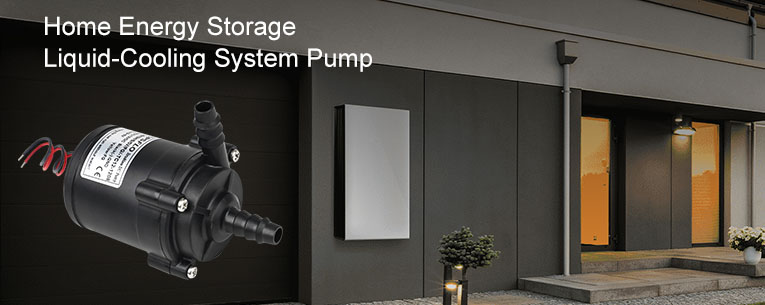
The circulating pump is often described as the “heart” of a liquid-cooled energy storage system.
Its responsibilities include:
1. Driving coolant circulation;
2. Removing heat from battery modules;
3. Maintaining stable coolant flow;
4. Supporting long-term continuous operation.
Selecting the right pump directly affects safety, efficiency, and system durability.
Key Features to Look For
When choosing a home energy storage liquid cooling pump, consider:
• Leak-free sealing performance;
• Long operational lifespan;
• Low power consumption;
• High reliability;
• Compact size;
• Intelligent control functions.
TOPSFLO has accumulated extensive experience in micro pump technologies across automotive, medical, charging infrastructure, and energy storage applications.
Its home energy storage liquid cooling pumps can be customized with features such as:
• PWM speed regulation;
• FG speed signal feedback;
• Failure alarm output;
• Compact structural design;
• Service life exceeding 50,000 hours.
These capabilities help support the long-term operational requirements of residential energy storage systems.
| Feature | Air Cooling | Liquid Cooling |
|---|---|---|
| Heat Dissipation Efficiency | Moderate | Excellent |
| Temperature Uniformity | Limited | Superior |
| Noise Level | Higher | Lower |
| Energy Consumption | Moderate | Lower |
| Support for High Energy Density | Limited | Excellent |
| Thermal Runaway Mitigation | Moderate | Better |
| Long-Term Operating Cost | Moderate | Lower |
| Future Scalability | Limited | Excellent |
While air cooling remains suitable for some entry-level applications, liquid cooling provides clear advantages as home energy storage systems evolve toward larger capacities.
Frequently Asked Questions
What is liquid cooling in home energy storage?
Liquid cooling uses circulating coolant to remove heat from battery systems and maintain safe operating temperatures.
Is liquid cooling safer than air cooling?
Yes. It offers more precise temperature control and reduces the risk of hotspots and thermal runaway.
Does liquid cooling consume more electricity?
Not necessarily. Improved heat transfer efficiency can reduce overall cooling-related energy consumption compared with traditional air cooling systems.
How long can a liquid cooling pump last?
High-quality brushless DC pumps can achieve service lives exceeding 50,000 hours under appropriate operating conditions.
Will liquid cooling replace air cooling completely?
Air cooling will continue to serve certain applications, but liquid cooling is expected to gain a larger share of the residential energy storage market as battery capacities increase.
Conclusion
The rapid growth of residential energy storage is reshaping expectations for safety, efficiency, and user experience.
While air cooling supported the industry’s early development, liquid cooling addresses the emerging challenges associated with higher energy density and longer service requirements.
By delivering precise temperature control, enhanced safety, lower operating costs, and smarter integration, liquid cooling is increasingly defining the future of home energy storage.
As the market continues to evolve, the transition toward the “liquid cooling era” appears not only possible—but inevitable.
Recommend you also directly send and email to info@topsflo.com to get our fastest response.



Recommend you also directly send and email to info@topsflo.com to get our fastest response.