+86-731-82739266
info@topsflo.com
The Leader of High-end Micro DC Pump in China

 +86-731-82739266
With the rapid development of cloud computing and big data technology, data centers have become critical infrastructure for enterprises and organizations to manage and store information. According to market research, the global data center market is expected to continue growing rapidly, increasing demand for efficient and reliable server cooling solutions.
As data centers continue to expand, energy consumption and heat dissipation have become major challenges. Efficient thermal management is essential to maintain stable server operation, improve energy efficiency, and extend component service life.
Among the available cooling technologies, liquid cooling provides an efficient solution for high-density data center servers. The liquid cooling pump is one of the key components responsible for circulating coolant and transferring heat away from the server.
This article explains how server liquid cooling systems work and the key factors to consider when selecting a data center liquid cooling pump.
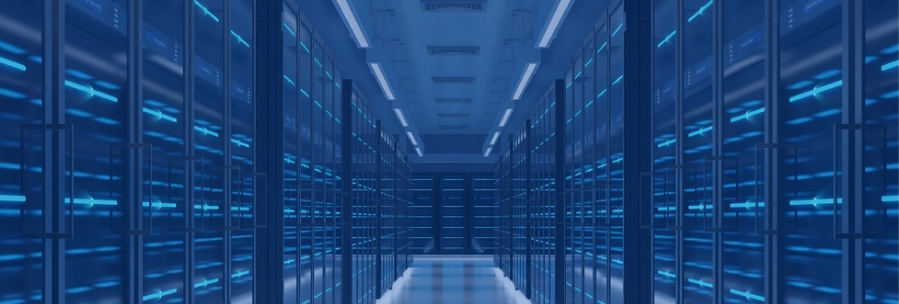
When servers operate, they consume significant amounts of electricity and generate substantial heat. If this heat is not removed efficiently, it can affect server performance, reliability, and component life.
Traditional data center cooling systems mainly rely on air cooling or conventional water cooling. However, as server computing density increases, traditional cooling methods face challenges such as:
Liquid cooling technology addresses many of these challenges by using liquid to transfer heat directly or indirectly away from high-heat components.
Compared with traditional air cooling, liquid cooling offers:
Therefore, liquid cooling is increasingly used in data center server cooling applications.
How Does a Liquid Cooling System Work in a Data Center?
A typical server liquid cooling system uses a pump to circulate coolant through the cooling loop.
The basic circulation process can be summarized as:
Liquid Cooling Pump → Cooling Component → Server Heat Source → Heat Exchanger / Cooling Unit → Liquid Cooling Pump
The pump provides the required flow and pressure to continuously circulate the coolant through the system.
In a typical system, the liquid cooling pump is installed in the liquid cooling system and delivers coolant through pipes to the cooling equipment inside or around the server rack. The coolant absorbs heat generated by the server and then returns to the cooling system, where the heat is removed.
This continuous circulation enables the system to perform heat transfer and heat dissipation.
The liquid cooling pump is a critical component of a server liquid cooling system because it directly affects coolant circulation.
If the pump does not provide sufficient flow or pressure, the cooling system may experience inadequate heat transfer, resulting in higher server temperatures.
Pump reliability is equally important. Because the pump operates continuously in many data center applications, pump failure can interrupt coolant circulation and potentially affect server operation.
Therefore, the performance of the server liquid cooling pump has a direct influence on the efficiency, stability, and reliability of the overall cooling system.
When selecting a liquid cooling pump for a data center server cooling system, four factors should be considered:
1. Pump Efficiency
Pump efficiency affects the overall energy consumption and operating performance of the liquid cooling system.
A high-efficiency pump can provide the required coolant flow and pressure while consuming less electrical power. This is particularly important for data centers, where cooling systems operate continuously.
Topsflo liquid cooling pumps use brushless DC motor technology and fluid-mechanics-based design to provide efficient operation, lower power consumption, and reduced heat generation.
For data center applications, pump efficiency should therefore be evaluated together with the required flow rate, pressure, power consumption, and operating conditions.
2. Pump Reliability
Reliability is one of the most important requirements for a data center liquid cooling pump.
Because the pump is a core component of the cooling loop, pump failure can interrupt coolant circulation and affect server thermal management.
Topsflo specializes in intelligent pump technology with features such as automatic control and self-protection. High-corrosion-resistance, wear-resistant, and pressure-resistant materials can also help improve pump durability and service life.
For continuous-duty data center applications, pump reliability should be evaluated based on operating life, materials, motor technology, protection functions, and application conditions.
3. Operating Noise
Although data center cooling systems are primarily designed for thermal management, operating noise is also an important consideration.
Pump vibration and motor noise can affect the overall acoustic environment of equipment rooms and data center facilities.
Topsflo liquid cooling pumps incorporate low-noise motor technology, precision rotors, and silent design features to reduce operating noise and vibration.
Low-noise operation is particularly beneficial for environments where acoustic performance is an important consideration.
4. Installation and Maintenance
The installation and maintenance requirements of a liquid cooling pump can affect the overall usability and serviceability of the cooling system.
Different data center cooling architectures may require different pump configurations, control methods, and installation positions.
TOPSFLO liquid cooling pumps provide multiple control options and installation configurations, allowing the pump to be adapted to different liquid cooling system designs and data center environments.
Easy integration and appropriate installation flexibility can help simplify system design, installation, and maintenance.
Topsflo has developed liquid cooling pump technology for applications requiring compact size, high efficiency, reliable operation, and low noise.
The B03 and TDC liquid cooling pumps are designed for liquid cooling applications and feature:
These characteristics make them suitable for different liquid cooling system configurations, including cooling circulation, heat exchanger circulation, and water tank cooling systems.
For more information, see the Topsflo Server Liquid Cooling Pump.
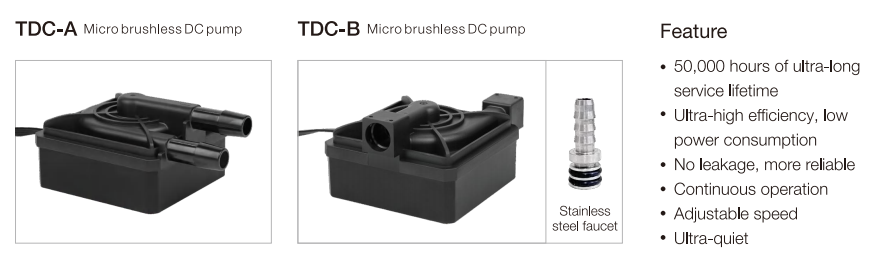
1U/2U Rack Server, Tower Server Liquid Cooling Pumps TDC Series
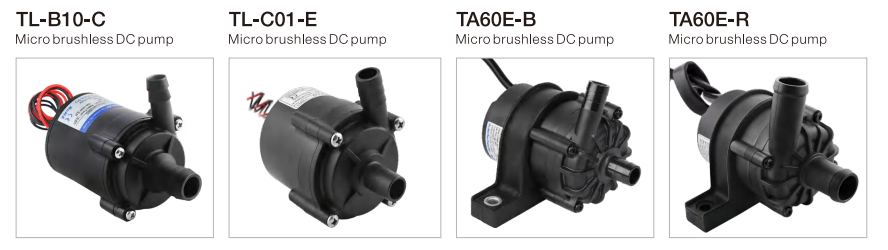
2U Server Liquid Cooling Pumps/AI Inference Server Coolling Pump TL Series
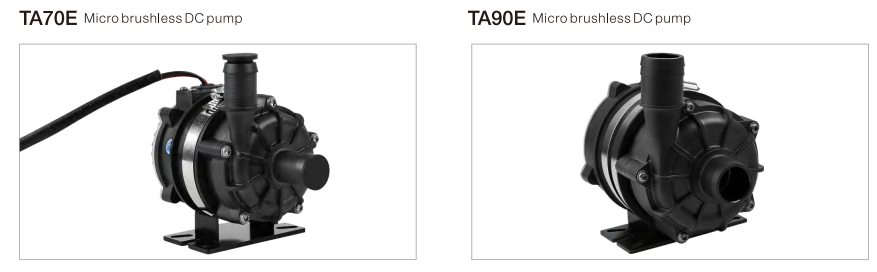
CDU(Coolant Distribution Unit) Liquid Cooling Pump TA70E TA90E
The selection of a server liquid cooling pump should be based on the actual requirements of the cooling system.
Key parameters to evaluate include:
| Selection Factor | What to Consider |
|---|---|
| Efficiency | Power consumption, motor efficiency, and required operating performance |
| Flow & Pressure | Required coolant flow rate and system pressure |
| Reliability | Service life, materials, protection functions, and continuous operation |
| Noise | Motor noise, vibration, and acoustic requirements |
| Installation | Pump size, mounting method, connections, and available space |
| Control | Required control method and system integration |
| Application Conditions | Coolant, temperature, operating environment, and duty cycle |
The right pump should provide sufficient flow and pressure while maintaining reliable and efficient operation under the actual working conditions of the data center cooling system.
Conclusion
As server computing density continues to increase, efficient thermal management has become increasingly important for modern data centers.
Liquid cooling technology provides an effective approach for managing the heat generated by high-performance servers, while the liquid cooling pump plays a critical role in maintaining coolant circulation and system stability.
When selecting a data center server liquid cooling pump, the key factors are:
Efficiency + Reliability + Low Noise + Installation & Maintenance
Topsflo will continue to improve its capabilities in intelligent control, high efficiency, energy saving, safety, reliability, and sustainable development, providing reliable pump solutions for data center liquid cooling systems.
Recommend you also directly send and email to info@topsflo.com to get our fastest response.



Recommend you also directly send and email to info@topsflo.com to get our fastest response.